From attorney to ordained deacon
An unexpected vocational journey brought Board of Trustees Chair Jeff Taylor to MTSO
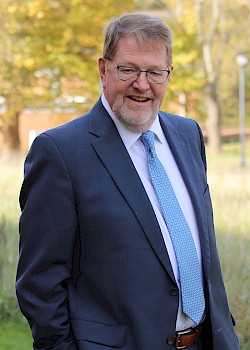 In the late 1990s, Jeff Taylor was a partner in a small Huntington, West Virginia, law firm. Though he was a lifelong United Methodist and active in his church, his professional aspirations had nothing to do with ministry. He knew trial law was his calling.
Then Taylor’s dad, a lay member to the West Virginia Annual Conference, suggested his son apply to be a lay member as well. “He said to me, ‘I think that’s something you would like.’ And I thought, ‘It doesn’t sound like anything I would like,’” Taylor recalled, laughing.
Father knew best. Taylor attended his first annual conference as a lay member in 1998. It began with a worship service. “From the very beginning, I had a lump in my throat because I had just never heard that many voices in unison.” Later, at a service recognizing retiring pastors, he noticed a common theme in the honorees’ remarks: I never wanted to be a minister, but I couldn’t get away from it. And it hit Taylor: “Uh-oh, I think their story might be my story.”
Today, a quarter-century later, Taylor is president of the United Methodist Foundation of West Virginia, a past president of the National Association of United Methodist Foundations and – thanks to years he spent traveling to MTSO for classes – an ordained deacon. He has served as an MTSO trustee since 2015, and on July 1, he began a three-year term as the board’s chair.
Four years after the “uh-oh” moment at his first annual conference, Taylor left his law practice for a position at the United Methodist Foundation. He ascended to the foundation’s presidency in 2008. While he loved his work, something gnawed at him: “In working with a donor, particularly when you’re talking about estate matters and end-of-life decisions, there’s a theological conversation that I felt ill-equipped to deal with.”
Because he held a law degree, Taylor could pursue ordination as a deacon by earning a Certificate in Deacon Studies. Though another seminary was closer, his friend and mentor J.F. Lacaria, a United Methodist deacon and MTSO trustee at the time, advised him to look into Methesco.
Taylor liked what he found. In 2010, 24 years after earning his law degree, he arrived for his first class at MTSO. “I walked in with my yellow pad,” he said, “and everybody else is plugging in their laptops.”
Soon he started bringing a laptop, too, and he eventually had his handwritten notes digitized. He still keeps his MTSO class notes and consults them “at least monthly” in preparing a sermon or a theological reflection.
While Taylor was taking classes, MTSO President Jay Rundell invited him to have a cup of coffee: “Jay told me part of his vision, which included the farm and the solar array. And this greater discussion around sustainability and ecotheology was exciting to me.” In 2015, the same year he earned his Certificate in Deacon Studies from MTSO, Taylor joined the board.
“Not only is Jeff a valued MTSO trustee,” Rundell said. “His story of an incremental move toward ministry is an inspiring example to others who are deciding how to answer the call they might be hearing.”
In addition to Taylor’s board service, he and his wife have begun the Mary and Jeff Taylor Endowed Scholarship Fund. “I loved my time as a student at MTSO,” he said, “and I know that there has been a struggle on the part of many students to get to seminary. And so those two things are working together to give back to the institution that I care so much about.”
As he embarks on his term as board chair, Taylor is optimistic about the future of MTSO and its relationship with the United Methodist Church in light of changes around LGBTQ marriage and ordination approved at General Conference earlier this year.
“I’ve talked to young people who did not want to go into ministry for the United Methodist Church, either because they couldn’t or because they didn’t want to be aligned with a church that excluded people,” he said. “I think the church is in a better place. I know a lot of churches are struggling because of those decisions, but I think it’s growing pains. Nobody said it would be easy.”